Dans les actes de baptême du XVIIeme siècle (pas d'actes de naissance a l’époque) on voit de temps en temps la mention "ondoyé[e] a cause du danger de mort par [untel]".
A partir de 1654, quand un évêque a prévenu les parents du danger qu'encourraient les nouveaux nés s'ils ne sont pas baptisés avant la mort, les parents ont pris des mesures pour s'assurer que quelque soit l'issue de l'accouchement, le bébé soit suffisamment baptisé pour ne pas finir dans les limbes.
Il était donc courant quand un enfant était né pendant la nuit que la sage-femme ou un voisin verse de l'eau sur la tête nue du bébé en disant "je te baptise au nom du Père, du Fils, et du Saint-Esprit". La cérémonie était considérée comme une version simplifiée du baptême suffisante pour sauver l’âme de l'enfant jusqu'au baptême a l’église (généralement le lendemain ou aussi vite que possible).
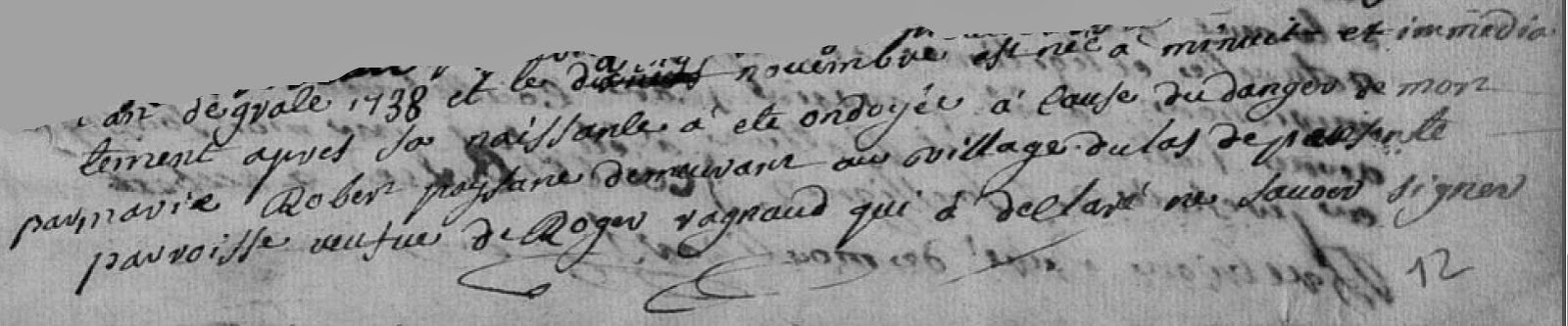

Transcription:
L'an de grace 1738 et le vingt novembre est née a minuit et immédiatement après sa naissance a été ondoyée a cause du danger de mort par marie Robert paysanne demeuran au village du clos de présente parroisse veuve de Roger ragnaud qui a déclaré ne savoir signer Laura Ragnaud fille naturelle et légitime de Rhemi Ragnaud et de jeanne martineau.
A partir de 1654, quand un évêque a prévenu les parents du danger qu'encourraient les nouveaux nés s'ils ne sont pas baptisés avant la mort, les parents ont pris des mesures pour s'assurer que quelque soit l'issue de l'accouchement, le bébé soit suffisamment baptisé pour ne pas finir dans les limbes.
Il était donc courant quand un enfant était né pendant la nuit que la sage-femme ou un voisin verse de l'eau sur la tête nue du bébé en disant "je te baptise au nom du Père, du Fils, et du Saint-Esprit". La cérémonie était considérée comme une version simplifiée du baptême suffisante pour sauver l’âme de l'enfant jusqu'au baptême a l’église (généralement le lendemain ou aussi vite que possible).
Transcription:
L'an de grace 1738 et le vingt novembre est née a minuit et immédiatement après sa naissance a été ondoyée a cause du danger de mort par marie Robert paysanne demeuran au village du clos de présente parroisse veuve de Roger ragnaud qui a déclaré ne savoir signer Laura Ragnaud fille naturelle et légitime de Rhemi Ragnaud et de jeanne martineau.
In 17th-century baptismal records (birth certificates did not exist at the time) one sometimes sees the note "baptised in emergency due to danger of death by [so-and-so]."
From 1654, after a bishop warned parents of the danger facing newborns who might die unbaptised, families took measures to ensure that whatever the outcome of the birth, the baby would be sufficiently baptised to avoid ending up in Limbo.
It was therefore common, when a child was born during the night, for the midwife or a neighbour to pour water over the bare head of the baby while saying "I baptise you in the name of the Father, the Son, and the Holy Spirit." The ceremony was regarded as a simplified form of baptism sufficient to save the child's soul until the church baptism (usually the following day, or as quickly as possible).
Transcription:
[In the year of grace 1738, on the twentieth of November, was born at midnight and immediately after birth was baptised in emergency due to danger of death by marie Robert, a peasant woman living in the village of Le Clos in the present parish, widow of Roger Ragnaud, who declared she could not sign — Laura Ragnaud, natural and legitimate daughter of Rhemi Ragnaud and Jeanne Martineau.]
From 1654, after a bishop warned parents of the danger facing newborns who might die unbaptised, families took measures to ensure that whatever the outcome of the birth, the baby would be sufficiently baptised to avoid ending up in Limbo.
It was therefore common, when a child was born during the night, for the midwife or a neighbour to pour water over the bare head of the baby while saying "I baptise you in the name of the Father, the Son, and the Holy Spirit." The ceremony was regarded as a simplified form of baptism sufficient to save the child's soul until the church baptism (usually the following day, or as quickly as possible).
Transcription:
[In the year of grace 1738, on the twentieth of November, was born at midnight and immediately after birth was baptised in emergency due to danger of death by marie Robert, a peasant woman living in the village of Le Clos in the present parish, widow of Roger Ragnaud, who declared she could not sign — Laura Ragnaud, natural and legitimate daughter of Rhemi Ragnaud and Jeanne Martineau.]